
FameGrafter™ was inspired in part by the legendary 1980s Spectrum game Rockstar Ate My Hamster, created by Colin Jones and Codemasters, though other Spectrum veterans will spot some stark differences in gameplay, and particularly a cautious avoidance of parodies of real stars.
What preceded it maybe more directly, but which itself was possibly inspired in part by Rockstar Ate My Hamster, was an idea of mine years ago that unsurprisingly never got off the ground, and which was for a spoof social media game website where people would adopt over-the-top fake celebrity personas, then try to earn fame points and so on by completing fictional jobs such as gigs, TV shows and so on, with an added splash of random gossip and scandal.
A green outline should highlight clickable buttons once the game gets going proper.
The game, the bulk of which was created in a playable offline version in mid-2021, is intended to be a generally light-hearted take on the world of fame and its capricious allure without demeaning the hard work and talent of real performers, who have the difficult task of entertaining, informing, educating, enlivening people's inner life and inspiring a sense of wonder and transcending the vagaries of experience, and to that end the arts don't run on perfection but people willing to have a go.
None of the aspiring TV performers and personalities is based on anyone real, and all were instead created by brainstorming. For some I tried to find unique, original names and for others I picked names shared by lots of people.
News and gossip events are meant to be a mix of good, bad, and neither - or depends on the circumstances, with a degree of randomness to how it affects their popularity. It's not intended to be judgemental, particularly for things such as people having complicated romantic lives or needing to check into rehab, but those things reflect some aspects of celebrity life and news, and as with a lot of things that's a caveat that stretches only so far within reason and acceptable ethical bounds. The key thing to remember is... it's a game.
The game mechanics are pretty simple. Any character picked one week won't be available the following week, which introduces a small tactical element for how to hedge on having someone with a relevant ability or someone who can wing it if a similar type of job comes up. The more that their own personal traits and specialisms match a job's themes, the better they are likely to perform. Likewise, more popular performers command bigger fees for them and for you as their manager.
Characters have hidden statistics scoring how well they perform across keyskills, namely acting, music, 'factual', art, comedy, dancing, and charm. Keyskill scores help to work out how well characters perform at a particular task. Although characters will be best in their main field, they will also have varying degrees of skill in other areas. In effect, some have hidden talents or are all-rounders.
From my own playtests, I find it makes good if not essential sense to have at least one musical character and one actor, then I'm still unsure what makes the best mix, whether it includes someone with general good speaking ability or a wildcard who might be an all-rounder, or whether personal taste will be a stronger definer of enjoyment.
Earnings scale to the type of job, so concerts earn more than gigs, albums than singles, and so on.
Each game year, the player's fictional talent agency needs to hit a certain financial target otherwise it folds. Complete the game by lasting five years.
In terms of performance scores, a test run with a decent mixed team and suitable characters generally sent on jobs, foudn an average score over 100 weeks of 22.58. Zero points can be regarded as a miss, a disaster or something really bombing. Anything from one to nine points is OK; 10-19 is good; 20 to 29 is really good; 30 to 39 is fantastic; 40 to 49 is amazing; and 50 and above is something best-in-field, potentially award-winning and beyong 60 is nearing masterpiece status.
Names of shows, films and other works are generated randomly according to theme, with two words or short phrases stitched together to form it. Some work better than others. Some are quite plain, some clunky, and some have genuinely caught me off guard and made me laugh, which isn't an easy thing to do, so I hope it's the same for other players. It's worth going with the flow without expecting too much to catch the ones that hit the mark. A future update might include something similar for news and gossip.
It doesn't use relative positioning and sizing, which means the gameboard will look a bit small on large screens, and on small screens the lefthand and righthand panels will be placed on top of one another instead of alongside. With the right screen size, the gameboard should look more or less like this:
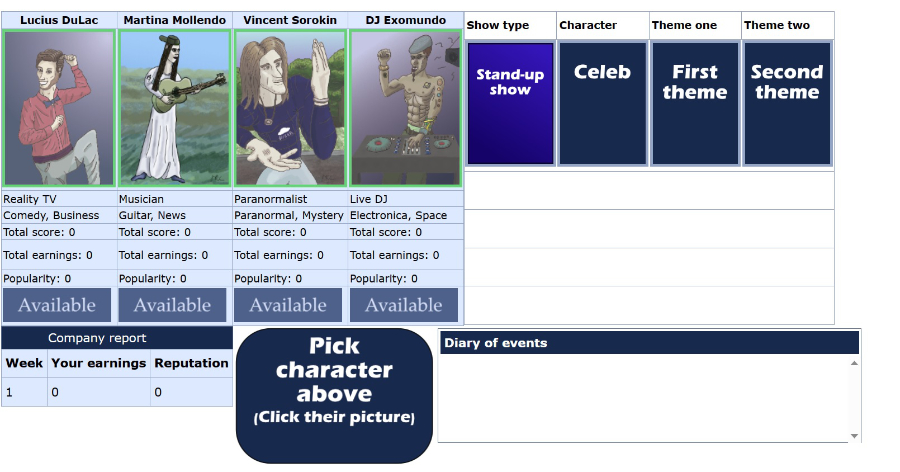
The game plays best on my system with the screensize at 90% for a wider view of all the relevant panels.
Characters are referred to as 'they' and 'them' because it's quicker and shorter to code than detecting their gender or pronoun preference every time.
The working title was the catchy and to-the-point 'Celebs: The Game', but at the last minute I opted for something more obscure in a bid to lower the chance of bumping up against anyone with IPO category 41 trademarks with the word 'Celebs'in the title. Another close contender was 'Fame, Foibles and Fortune', which maybe captures the spirit of the game more. The 'graft' part refers to hard work; not bicycle theft, as some might know the word, nor medical procedure.
I hope you enjoyed playing FameGrafter™, and if you did, or maybe even if you didn't, you might also like to try the game that preceded it: Election Run®."